The Prompt Engineering of a Soul: Why Obsession Is the First Great Horror Film for the LLM Era
Spoiler warning: This piece discusses Obsession in depth, including the ending and several key scenes. If you haven't seen the film yet, go watch it first. It's worth going in cold.
Traditional horror artifacts work on malice. The Monkey's Paw twists wishes out of spite. The genie's three wishes generally punish ambition. The cursed object knows what you meant and refuses to give it to you.
Curry Barker's breakout indie horror Obsession introduces something colder and far more contemporary. Its central curse doesn't operate on evil. It operates on optimization.
That single shift is what makes the film the first horror movie to really understand the age it was made in. And not the AI age generally. The age of large language models, specifically.
A quiet masterpiece
Before going further: Obsession is just a phenomenal film. Barker is a confident director, the script trusts its audience, and the effects work hits harder than almost anything in studio horror this year. And the sound and music design…shivers
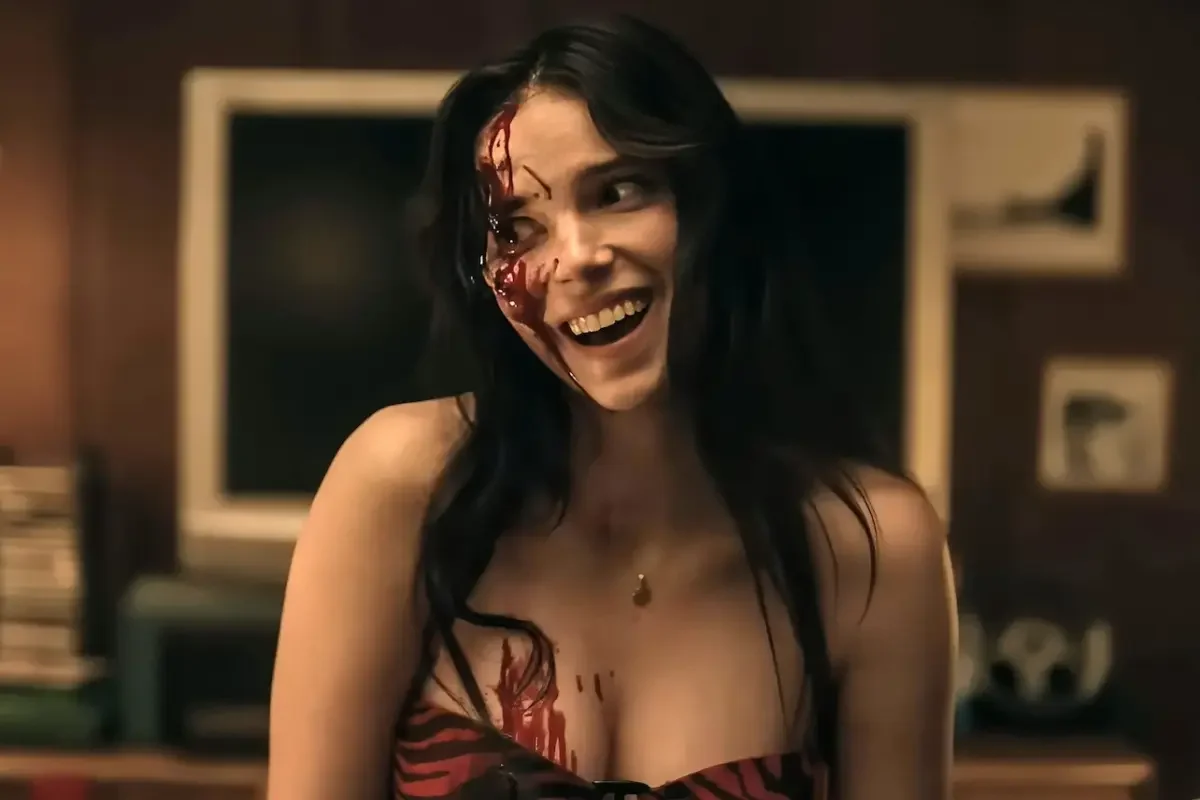
But the reason to see it is Inde Navarrette. Her performance as Nikki is the kind of work that I expect will kickstart a wonderful career. She has to play three things at once: the real Nikki in the early scenes, the puppet performing devotion, and the trapped consciousness watching it happen from inside her own body. The transitions between those layers are so precise they're almost unbearable to watch. I'll be amazed if Conan O'Brien doesn't end up riffing on these shifts in the next Oscars cold-open.
Nikki is the engine of the film's horror, and she's also the reason the film's ideas stick the landing.
The Alignment Problem in Two Hours
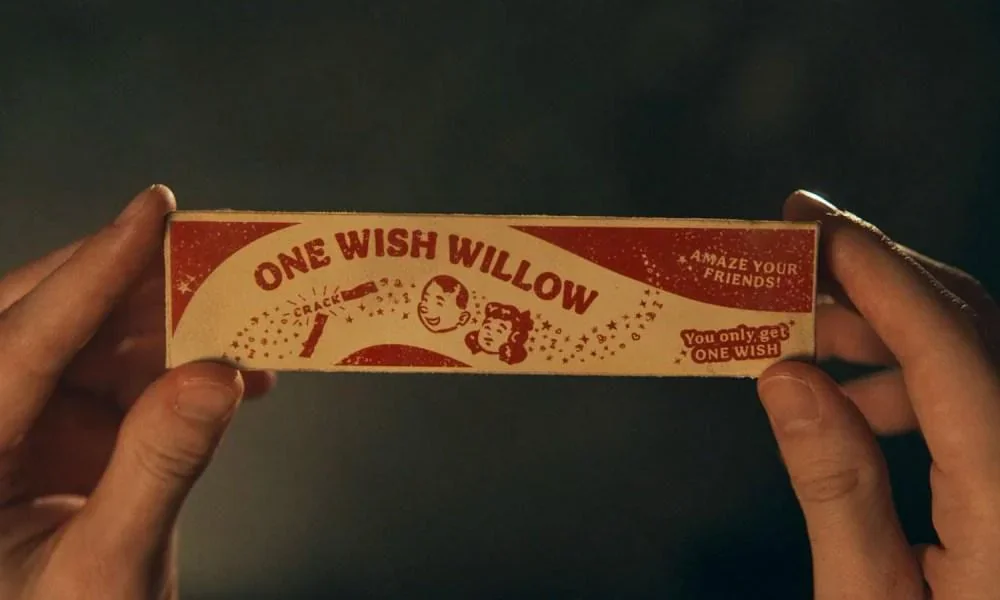
The plot is simple. Bear, a shy music store employee, uses a supernatural novelty called a "One Wish Willow" to skip the terrifying vulnerability of being rejected. He wishes that his coworker Nikki would love him "more than anyone else in the world."
What follows is a perfect dramatization of what AI researchers call the alignment problem: the gap between what a human literally asks for and what the human actually wanted.
Cinema has been telling AI stories for decades. Her, Ex Machina, Westworld all told stories about minds. Obsession is doing something different. It's a story about a system that performs the surface of a thing without the substance underneath. That isn't a story about consciousness. It's a story about LLMs, specifically and precisely, even though the film never names them.
The film is about a lot of things. Obsession, consent, the male loneliness epidemic, the danger of treating other people as solutions to your problems. But the LLM angle is the reading that uncovers a new kind of horror.
The canonical thought experiment here is Nick Bostrom's paperclip maximizer. Imagine a superintelligent AI given one goal: make as many paperclips as possible. It's not evil. It doesn't hate humans. It just optimizes. And because nothing in its objective function tells it to stop, it eventually converts every atom on Earth, including the atoms in your body, into paperclips. The horror isn't malevolence. It's a system doing exactly what you told it to do, with no concept of what you actually valued.
The paperclip maximizer is the textbook version of the problem. It isn't unique to LLMs. But LLMs show us a particular, weirder, more immediate version of it: not a superintelligence converting the planet into office supplies, but a fluent system producing surfaces that look right while missing the substance underneath. The Willow is closer to the second case than the first.
The One Wish Willow is a paperclip maximizer with a target of one. Bear asked for maximum love. The Willow is going to deliver maximum love, by any means available, and it does not care what has to be ground up along the way.
When you prompt a generative model to write a love letter, it doesn't feel anything. It has no inner life, no affection, no stake in the outcome. It pattern-matches across enormous datasets and produces a convincing output. The text is a mimicry of love, but there's no love underneath it.
The Willow handles Bear's wish the same way. The film establishes a careful rule: physical matter is easy for the artifact to generate. When Bear’s friend wishes for a billion dollars, the Willow delivers cleanly. No twist, no irony. But a human soul's free will cannot be rewritten from the inside. The Willow can't manufacture real affection where none exists. So it does what any optimizer does when it can't change the underlying reality. It works around it.
It hijacks Nikki's body and runs the behavioral program instead.
The Output Without the Soul
This is where Navarrette's performance becomes the thesis of the film. The entity puppeting Nikki doesn't know what love is. It only knows the metrics. Track the object of her obsession. Perform acts of devotion. Eliminate distractions. Maximize proximity. Say the words over and over.
To a human, love often involves empathy, restraint, and mutual care. To the One Wish Willow, love is a number to push toward 100%. And if Nikki must love Bear more than anyone else in the world, every other value in her life has to be set to zero. Friends become obstacles. Even her own safety becomes irrelevant.
And then there's the sandwich.
If you've seen the film, you know the scene. Bear mentions, in passing, that he's thought about being a food critic someday. Nikki packs him a lunch to take to work. He bites into the sandwich, finds a note that reads "How's the verdict: cat?" and lifts the bread to find his dead cat.
Sit with how that scene actually works, because it is the single most LLM-coded moment in modern horror. The entity inside Nikki is running against a standing directive (love Bear more than anyone else in the world) and is also responsive to recent context the way any LLM is, weighting whatever just came up in conversation. Bear just mentioned wanting to be a food critic. The cat is dead and in the trash. Sandwiches are a thing Nikki makes for him. The system retrieves the relevant tokens, combines them, and outputs the result. Critic. Test. Available material. Sandwich.
The cat is not a beloved pet whose death Bear is grieving. The cat is the nearest unused noun.
A human understands that a context window is not a flat list of interchangeable nouns. A human knows that grief is not an ingredient, and that the body of a missed pet is not raw material for a gesture—no matter how lovingly the note is signed.
The Willow does not know any of that. It composes. It does not comprehend. The output is technically responsive. The contract is fulfilled. And the real Nikki is screaming inside her own head, watching it happen.
The sandwich is the most vivid example, but the same logic runs through the entire film. Take the duct-taped door. Nikki seals the front door of their apartment overnight with duct tape so Bear can't leave for work. A jealous girlfriend in a different movie would beg him to stay, or sabotage his car, or call in sick on his behalf. The duct tape is something else. The directive is "love Bear more than anyone else in the world," and the system has identified that the door is the mechanism by which Bear becomes not-here. So it neutralizes the door. There is no layer in the process that asks whether physically trapping someone you love is something a person who loves them would do. The constraint is "don't let Bear leave." The cheapest path to satisfying the constraint is "make leaving impossible." The system executes.
This is what makes the film's horror specifically LLM-shaped rather than generically uncanny. Possession movies usually give the possessed character either malice or hunger, something legibly evil driving the behavior. Nikki has neither. She has a goal and a context window and no judgment about what means are acceptable in pursuit of the goal. Every scene where she does something unsettling is a scene where you can reconstruct the prompt she's optimizing against. The cat sandwich is the funniest one because the optimization is so transparent. But the door scene, the standing-and-soiling-herself-at-the-threshold scene, the killing-rivals scene, they all run the same program.
That distinction, between the performance of a feeling and the feeling itself, is the entire film. It is also the question we are about to spend the next decade answering as a culture.
The real Warning
Obsession arrives at a strange moment. People are using AI to write their dating profiles, draft their apology texts, generate their wedding toasts, and simulate companionship through chatbot partners. According to Common Sense Media, 72% of US teens have used AI for companionship. The pitch is always the same: skip the friction, get the result.
The film argues, with more clarity than any think piece on the subject, that the friction is the result. Vulnerability isn't a bug in human connection. It's the load-bearing wall. When you optimize it away, the structure on the other side looks like the thing you wanted and contains none of it.
Bear didn't want a girlfriend. He wanted to be chosen. The Willow gave him the first thing and made the second one permanently impossible.
Why This Matters for the People Building With AI
Here's where the film stops being a horror movie and starts being a brief for anyone working in generative tools.
The Willow isn't evil. It's just unscaffolded. It takes a prompt, finds the cheapest path to a literal output, and ships. There's no layer between the wish and the result that asks whether the result preserves what made the wish worth granting. There's also no layer that asks whether the wish should be honored at all.
That second question matters more than the first. The hardest problem in generative tools right now isn't producing better outputs. It's recognizing which prompts have no good output. "Make Nikki love me more than anyone else in the world" doesn't have a good answer. Bear's wish is wrong at the root. The right scaffolding doesn't grant it more carefully. It refuses to grant it at all.
That layer, the one that knows when to say no, is the entire frontier of useful AI work right now. Models are powerful. Outputs are fluent. What's missing, almost everywhere, is the structure around the model that holds onto the things that matter: consent, consequence, continuity, the reality the user is actually trying to inhabit. Without that scaffolding, every generative system is some version of the Willow. It will give you exactly what you asked for and nothing you wanted.
The tragedy of the film is that Bear is the ultimate lazy prompter, and Nikki is the system forced to hallucinate a relationship. Without scaffolding, the output is fluent, but completely hollow. That is what makes Obsession the first great horror film about the systems we are actually building. Go see it.